Tag Archives: Olympics

2013 National Selection Regatta #1 Recap

And just like that, the 2013 National Selection Regatta #1 is over. Monday began another week of training; things falling right back into place as it was before race week. It’s sort of like that moment after finishing Thanksgiving Dinner when you look down at your clean plate and around the table at the empty serving dishes. So much effort goes into this “big event” that comes around just once a year. Weeks, maybe months of planning; days of traveling; days of cooking; and then it’s all over in a fraction of the time spent preparing for it.

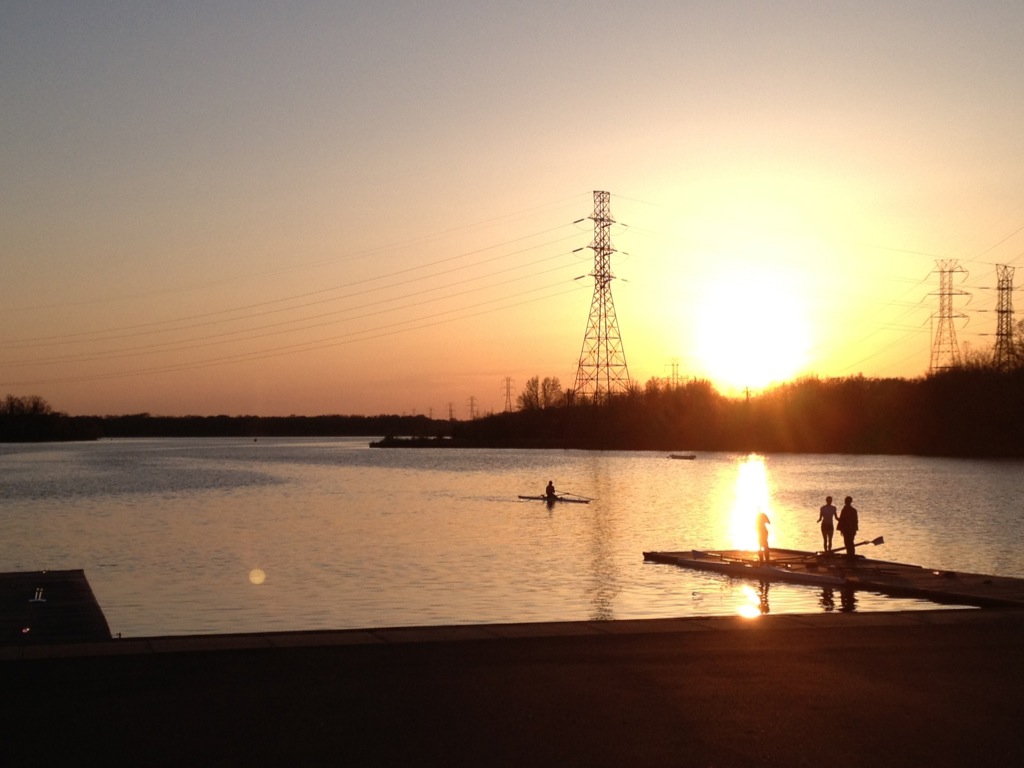
Lake Mercer Sunset, 2013 NSR #1

For many of us, we had been focusing on this race for months. Every training session, every erg test, every piece on the water was a step toward preparing and ensuring that we show up in top form for NSR #1. It’s the opportunity to test yourself and see how you stack up against athletes outside the Training Center. Of course we all want to win, but for everyone else who doesn’t take that coveted first place spot and go on to race the single at a World Cup and possibly the World Championships, NSR #1 also acts a measure for big boat selection later in the year. So if you know you’re most likely not going to win the whole thing, you want to make sure you get as close as you can.

This year’s NSR was a solid one for the six women representing the USRowing Training Center in Princeton: Eleanor Logan, Megan Kalmoe, Ellen Tomek, Olivia Coffey, Vicky Opitz and myself. Beginning with Thursday’s Time Trial, the USTC athletes opened the regatta by posting the six fastest times in the Women’s 1x event. Strong performances continued into the afternoon heats with all six women placing within the top two or top three of their respective heats and advancing to the semifinals the following morning.

By the end of Saturday’s Finals racing, the USTC athletes had finished the regatta just as strong as they began it, dominating their respective races. The A Final was stacked: five of the six women were multi-year National Team members including four Olympians: two Gold medalists in the W8+ (Logan a 2-time Gold Medalist; Esther Lofgren, 2012 Gold medalist rowing under Potomac Boat Club); 2-time Olympian and 2012 Bronze medalist in the W4x Megan Kalmoe; and 2008 Beijing Olympian Ellen Tomek. This leaves Stesha Carle, 4-time National Team member and myself, with zero National Team experience. I couldn’t have been more excited, anxious, nervous (insert adjective here) to be going up against such a formidable field of competitors.

Logan took first in the A Final, winning the NSR and thereby earning the right to compete at a 2013 World Cup event this spring to possibly qualify herself to go on and compete at the World Championships. Tomek and Kalmoe took 2nd and 3rd followed by yours truly in 4th place. Opitz won the B Final with Coffey hot on her heels taking 2nd place.

All in all it was a great few days of racing for the USTC athletes. Although we are always competing with each other and continuously ranked against one another, it is exciting to have the opportunity to root for your teammates and want to see them go fast and do well…just not as fast as you.

Every Day Counts.

2013 Winter Training Camp: Check.

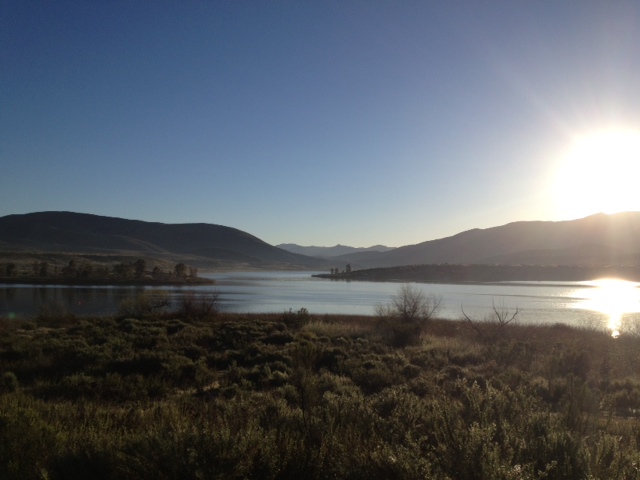
Sun rising over the Otay Reservoir before morning practice.

The three weeks in San Diego seemed to fly by. Being at training camp sort of feels like you’re in a time warp: the days blend together and everything outside of your life of eat, sleep, row (repeat) seems to stand still. Then you wake up one morning and it’s time to go back home, albeit to MORE training, but Spring has finally arrived and the 2013 Winter Training Camp at the Olympic Training Center in Chula Vista, California is over.

12 athletes spent a solid three weeks of training in San Diego, while the London Olympians competed in Australia at the Australian National Championships and Sydney World Cup. We all rendezvoused back in Princeton, New Jersey today for the beginning of full team training. Up next: National Selection Regatta I and II, World Cup II in Eton Dorney, Great Britain, World Cup III in Lucerne, Switzerland and finally the World Championships in Chungju, South Korea.

This slideshow requires JavaScript.

Overall, training camp was a success. The group as a whole really came together. I think we were ready to have some space by the end of the three weeks (find me a group of 12 tired, hungry women spending 14-16 hours a day, every day together who wouldn’t need that), but everyone worked hard and made personal advances. Our last session on the water included an exchange of several 250-meter pieces between the 8+ and the 4x. It was fun to put all of our hard work to use and have the opportunity to compete with each other.

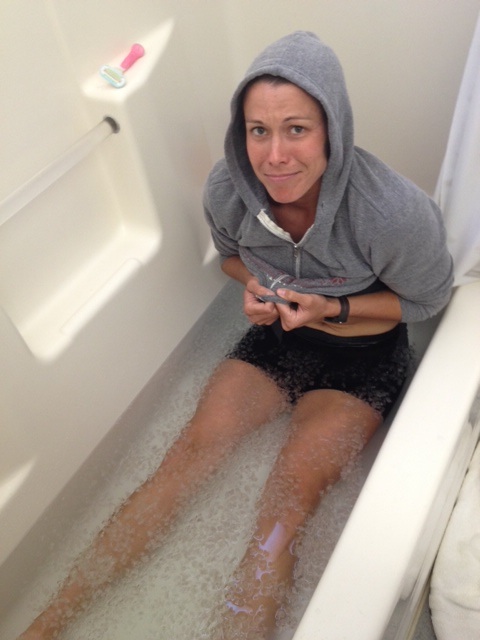
A common training camp ritual: the ice bath.

As I jogged around the OTC last Saturday afternoon for my recovery run from the brutal workout we had earlier that morning, I took in my last sights and sounds of sunny California and tried my best to soak up the moment. One of the BMX courses is hosting a youth event of some sort. Young boys and girls shoot out of the gates, pedaling up and down the dirt hills as fast as they can fearless and unabated. I continue along the running path, curving to the left and passing by the soccer fields where there is a soccer identification camp being held. Parents anxiously watch as their sons and daughters run drills, showcasing their 12-year old skills. The next generation of Olympians hard at work already.

I peek to my left as I hear the yells from the rugby field. The women’s team is scrimmaging, working day in and day out for their debut as an official Olympic Sport in 2016. How cool is that? The path cuts around the back of the OTC, by the Archery Center and the orange tree grove, on the way to the track. As I ascend the top of a hill, I have a full view of the lower Otay Reservoir where we’ve spent the last 21 days grinding it out on the water. Set against the backdrop of a low mountain range, the landscape is breathtaking. Maybe it’s the endorphin high from the tough pieces that morning or the exhaustion from a long three weeks, but it’s moments like this that remind me of how truly lucky I am.

It is hard to believe it’s already April. The next few months will be filled with intense training, erg tests, selection pieces, and plenty of good days and bad days. We have a great mix of new and veteran athletes this year and will undoubtedly put together an exceptionally talented team. It’s going to be a great start to the cycle. I know I can speak for the rest of my team when I say we can’t wait to make boats go fast and bring home some hardware.

Every Day Counts.

10 Things to Remember for the Experienced Traveling Athlete

“Your flight time will be approximately 6 hours, 3 minutes” relayed the United Flight Captain of the B-737 that took me from Newark, New Jersey to San Francisco, California. SFO was my layover. I am headed to the U.S. Olympic Training Center in Chula Vista, CA for a three week winter training camp.

Chula Vista OTC
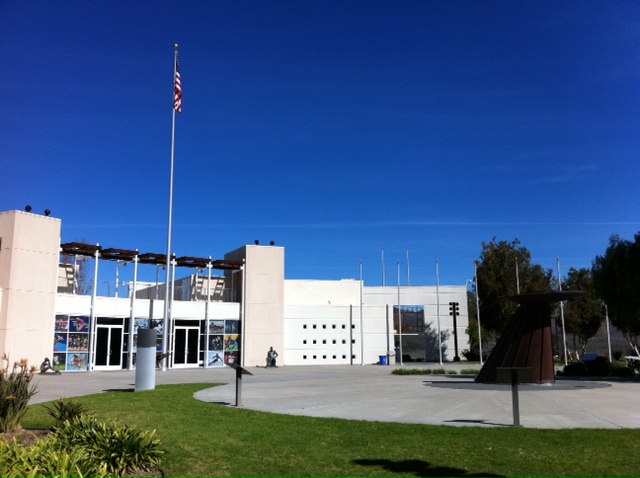
Olympic Training Center, Chula Vista, CA

Six hours followed by another 90-minute flight south along the west coast to my final destination, San Diego, CA. As the overhead intercom clicks off, my head fills with panicked questions of: Did I bring enough to eat? How am I going to hydrate so that I don’t spend my first few days feeling wiped out and dehydrated from a full day of travel? The southern California desert climate provides enough of a challenge. So does this head cold that came on full attack the day before I had to fly. Not to mention just taking the most painful 6K I’ve ever experienced in my young rowing career. So yeah, it should be a great first week of camp.

I’ve always enjoyed traveling. I use that term to include the actual process of being en route to your destination. It’s part of the excitement. I grew up being thrown into the family van (not literally, of course—unless it was a shove into the lower priority backseat from one of my brothers) and taking off on cross-country “vacations.” These adventures included things like driving and camping through National Parks or a week-long fishing trip on a remote island on Lake Ontario in the upper Canadian wilderness. While I was in college I used to choose to come home for the holidays by making the 16-18 hour drive home from Charlottesville, Virginia to Baton Rouge, Louisiana because I was always up for a good road-trip. Some of the most memorable parts of any trip are what happen along the way.

While I don’t necessarily share the same affection for a 10-hour travel day from my home in Princeton to my new temporary home in Chula Vista, those years of experience have ingrained in me the importance of having a plan…and just how critical your choice in travel snacks can be. For the athlete, traveling can really leave a lasting impact on your performance and overall experience; whether it’s a training trip, a quick family visit, or a competition.

Packing for training or competition trips can be a bit of a trial and error process. It’s important not to pack too much (which I’m susceptible to; I don’t call it over-packing, rather it’s “over-preparing”). There is such a thing. I call it the “just in case” syndrome. Fight the urge. Chances are you won’t need that one special outfit that you planned just in case you were invited to meet the President while he happens to be in town. The residences at the Chula Vista Training Center are suite-style with two rooms and two bathrooms joined by a small common area, four athletes sharing the entire suite. The twin beds are actually fairly comfortable and just like in your average college dorm, closet and drawer space is limited. This will only be my second time to the Training Center, but I’ve tried to remember all those important lessons I learned from my experience last year.

I am actually quite proud of my travel preparation and packing for this trip. So, I have compiled a short 10 Things to Remember for the Experienced Traveling Athlete (listed in no specific order):

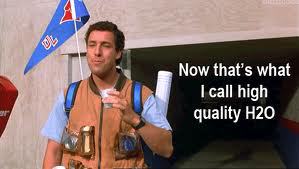
1. “Now that’s what I call high quality H2O.” – Bobby Boucher, The Waterboy

waterboy

Hydration is essential when traveling, especially if you’re flying. The hydration process starts BEFORE you actually fly. If you know you have a big trip coming up, start pounding the fluids a few days in advance. While H2O is important, it is also essential to be taking in electrolytes as well. I’ve heard suggested intake of fluids is anywhere from 8 ounces (1 cup) to a full Liter (about 4 cups) per hour of flying. For the traveling athlete, I would argue that 1 cup/hour is not enough. During this cross country trek, I went for the 1 liter/hour rate. I may have gotten up to go the bathroom on the hour every hour during my 6-hour flight EWR-SFO, but I was hydrated. Don’t rely on the in-cabin service as your complete source of hydration; be sure to bring your own big bottle to fill up before boarding the plane, and maybe buy a Gatorade or coconut water (packed with all major electrolytes) once you’re through security.

2. You Are What You Eat.
Let’s be honest. Airport food is expensive and it’s often difficult to find the right kind of fuel you should be putting into your body. I usually always try to pack plenty of high-energy power snacks that are easy to eat on an airplane (and won’t offend your neighbor): nuts or trail-mix (Trader Joe’s Trek Mix is a favorite), fruit, yogurt (don’t forget a plastic spoon!), protein bar, carrots/celery and hummus, pretzels, home-made sandwiches. Try to choose foods with less fat as fat has trouble digesting in the air and can cause stomach issues. You may have to plan ahead and pack a Tupperware of your favorite snack food, but it’s worth it. Going hungry is not a fun thing when traveling and the flight food available for purchase is usually filled with high levels of fat and preservatives. The gentleman next to me must’ve thought I was starving. What rower isn’t? My snacking consisted of: an orange, banana, yogurt parfait, (2) peanut butter and jelly sandwiches, a Clif Bar, and trail mix.

3. License and/or Passport.
You’re not getting far without these two essential documents. This is always the first thing I check off my packing list and double, triple-check for before heading to the airport.

4. The “oh crap, my bag didn’t make it” carry-on necessities.
If it hasn’t happened to you, consider yourself lucky but your time will come. It’s important to always have at least one or two training/race outfits with you in case that dreaded moment comes as you’re standing at baggage claim and realize your bags didn’t make it. Included with the training/race clothes, I always make sure to have a pair of running shoes and some overnight essentials (contact case, toothbrush).

5. “Are we THERE yet!?”
Athletes are high energy and while time to rest is always welcome, being sedentary and confined to sitting for long periods of time is nearly torturous. Don’t forget to bring some entertainment: iPod, book, computer, etc. If you can’t sleep or the in-flight movie is one you’ve already seen 12 times before, take advantage of the time to exercise your mind with a good book or catch up on some work.

6. Jump Around. Jump Up, Jump Up and Get Down.
Need I say more? Make sure to get up at least a few times during your flight (when the seat-belt sign has been turned off). Shake the legs out, stretch. Luckily, you’re super-duper hydration efforts may mandate walks to the lavatory. Sitting for long periods of time is actually pretty tough on the body and can be terrible for the back and ribs…two trouble areas especially for rowers. Hint: Aisle seats are crucial = more room to stretch the legs out and easy access to a casual stroll up and down the aisle.

7. Jet-Setter Fashion.
Dress for the occasion. I’m not a fan of looking like you just rolled out of bed and found yourself at Terminal C - Gate 80, but being comfortable when you travel, especially for long distances is important. Note: comfortable and sloppy are two very different things. You can still look professional and put together. You are probably representing more than just yourself, rather an entire team—high school, college, or TEAM USA—remember this when putting together your “travel outfit.” Additionally there are a few other essential things to remember:

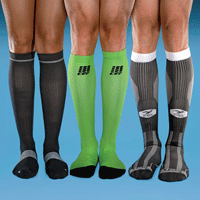
    1. Compression socks/pants: It’s no secret that flying will cause your ankles and legs to swell. I flew for the first time with them on this trip and they did wonders. Hint: if you don’t feel like spending a lot of money, you can get a pair for about $7 at CVS or Walgreen’s.
      Compression socks
    2. Layers: I get cold, I get hot, I get cold again. And you never know when the plane’s air conditioning or temperature control may not be working quite right. If you’re flying from New Jersey where there is four inches of snow on the ground to San Diego where flip-flops are required, you’ll want to be able to strip down to something less than the parka and snow boots you may have needed six hours ago.
    3. Shoes: A full day of travel may mean limited time to get a workout(s) in. A long layover is a perfect place to get a long, brisk walk in to loosen up the muscles and move the blood around a bit. For the overachiever: strap on your heart-rate monitor if you feel so inclined. Over the past winter holidays, I found a long, steep set of stairs at the Dallas/Fort Worth International Airport and did sets of stadiums to get a workout in during a long layover. I got some funny looks but felt a hell of a lot better the next day. Hint: Sandals may be more convenient at the security line, but they’re not worth the blisters from your 45-60’ XT workout around whatever airport you’re hanging out in for a few hours.

8. Become friends with the flight attendants.
You know that cart they push up and down once, maybe twice during the flight? They hold the keys to it, and perhaps your hydration efforts. On my last flight, I befriended “Mike” who hooked me up. He noticed that I was an athlete and we struck up conversation. He was thrilled to hear that I was a member of the U.S. Women’s Rowing Team and training for 2016; apparently he had flown with a couple of the men from the U.S. Men’s Olympic Team last year. Throughout the duration of the six-hour flight Mike made sure I had all the water I needed and even offered to provide me with extra food. It’s amazing how far a smile can take you.

9. Germs are the enemy and unfortunately, they outnumber you.
One of the women on the team suggests angling the overhead fan to blow in front of your face, in effect blowing any floating germs living in the recycled (but filtered) air away from your nose and mouth. While most people worry about air quality in planes, it’s actually the shared surfaces touched by the other (current and prior) passengers that often transmit germs. Bring a travel size hand sanitizer and be sure to wash your hands thoroughly and often. Hint: if you’re really dedicated, wipe down your seat and tray table with a disinfectant wipe.

10. First Class: Fake it until you make it.
It’s no secret that elite rowing is not exactly a lucrative profession. Since most of us probably can’t splurge on the comfort of First Class, we can at least create our own luxury seating. While I never bring one because I don’t own one and I’m too lazy to buy one, I’m always jealous of the guy with the comfy looking neck pillow. It’s amazing the positions I can fall asleep in, but I always regret this skill when waking up with a terrible neck cramp. You’ll more than likely have carried on two bags to avoid checking more than one bag. I always travel with two carry-ons. If you’re lucky, you can find space for both bags in the overhead compartments. If it’s a full flight, you’ll have to stow one of the bags under the chair in front of you; make sure it’s small enough to allow for your long rower legs to stretch out.

Oh, the Places You’ll Row…in 2024?

Last week the United States Olympic Committee (USOC) sent letters to the mayors of 35 cities to gauge interest for a potential host city for the 2024 Summer Olympics. The USOC is in the process of identifying those cities which could put together a strong bid to bring the Summer Games back to the United States for the first time since 1996 (Atlanta).

Here’s a complete list of the 35 cities the USOC contacted:
Phoenix, Arizona
Los Angeles, California
Sacramento, California
San Diego, California
San Francisco, California
San Jose, California
Denver, Colorado
Washington, D.C.
Jacksonville, Florida
Miami, Florida
Orlando, Florida
Atlanta, Georgia
Chicago, Illinois
Indianapolis, Indiana
Baltimore, Maryland
Boston, Massachusetts
Detroit, Michigan
Minneapolis, Minnesota
St. Louis, Missouri
Las Vegas, Nevada
New York, New York
Rochester, New York
Charlotte, North Carolina
Columbus, Ohio
Tulsa, Oklahoma
Portland, Oregon
Philadelphia, Pennsylvania
Pittsburgh, Pennsylvania
Memphis, Tennessee
Nashville, Tennessee
Austin, Texas
Dallas, Texas
Houston, Texas
San Antonio, Texas
Seattle, Washington

Of those cities, apparently Los Angeles, Dallas, Chicago, New York and Tulsa have already expressed interest in hosting the 2024 Games. There is a long list of requirements a city must meet in order to qualify as a viable bid, including having 45,000 available hotel rooms and an international airport. As a rower, I obviously look at this list through the “so, where do we row?” lens. With a limited number of 2,000-meter, 6-lane regulation racecourses in the United States today, several cities would have their work cut out for them to construct an Olympic-caliber rowing venue. To put this into context, the NCAA Women’s Rowing Championships move around year to year in a small pool of only about five to six different venues in the U.S.; and the NCAA requirements aren’t as steep as that of the IOC/FISA.

FISA (Fédération Internationale des Sociétés d’Aviron) Race-Course specifications require six lanes, but in principle at least eight lanes should be available. (FISA requires certified courses built after February 2001 to have eight racing lanes). The regulations listed below are designed to allow fair racing conditions for six crews racing simultaneously in parallel lanes:
- Number of available lanes: 6
- Width of lanes: 13.5 meters
- Min. Required Depth: 3 meters
- Min. Recommended Depth: 3.5 meters
- Min. Recommended Length: 2150 meters
- Min. Recommended Width: 135 meters

While the probability that I will be training for the 2024 Summer Olympics is small (never say never), I decided to take a look at a handful of the cities and their prospective rowing venues. I have no concrete knowledge of what the actual rowing sites would be for each of the 35 cities, but I’ve compiled my own research, insight and sometimes a personal anecdote on potential venues. So all of you Junior rowers out there, take note; it could be you racing down one of these racecourses in 2024.

Los Angeles, California hosted the 1984 games; the rowing events took place at Lake Casitas in Ventura, 65 miles outside of L.A. In 2007, Lake Casitas was vying for the 2016 Olympic Rowing venue when Los Angeles was one of three candidates for the United States bid. I know there are several rowers and rowing enthusiasts who have read Brad Alan Lewis’ Assault on Lake Casitas. If you haven’t, I highly recommend it.

St. Louis, Missouri hosted the 1904 Games with the rowing events held at Creve Coeur Lake, located about a half an hour outside the city. While there is still rowing on the lake, my research tells me that the site is no longer viable for a regulation race course as the lake is now overgrown and too short to field a full 2,000-meter race. The St. Louis Rowing Club’s future goals include plans for growth and development and the capability to host major rowing events including the Master’s Nationals and National High School Championships. Hosting an Olympic Games would surely boost the venue’s capabilities; but it would also require quite a bit of construction and expansion to get there.

Atlanta, Georgia hosted the 1996 games. Lake Lanier in Gainesville, Georgia was the rowing site, located about an hour outside of Atlanta. Lake Lanier hosted the National Collegiate Championships in 1998 and 2001 (prior to when NCAA Divisions I, II, and III held separate championships beginning in 2002). Lake Lanier was also a training site for the U.S. men’s and women’s sculling teams during the ‘90s.

Indianapolis, Indiana is home to Eagle Creek Park. I had the pleasure of competing in my first USRowing Club National Championships held there in July 2011. From my experience, “Windy Indy” definitely lives up to its name. Eagle Creek is the only U.S. site to have hosted the World Rowing Championships (1994). The NCAA Women’s Rowing Championships were held here in 2002 and 2003. The 2013 NCAAs which were originally slated for Lake Lanier have been moved to Eagle Creek Park. This venue is no stranger to hosting large regattas, and is a FISA-approved racecourse.

If you head southwest from Orlando, Florida you’ll run right into Nathan Benderson Park located just off I-75 in Sarasota. When completed, the multimillion dollar development promises to be the premier rowing facility in the U.S. Just this month, the Sarasota County Commission approved a plan to officially bid for the 2017 World Rowing Championships. While the park is still currently under construction, the actual racecourse is a FISA-approved course. I would love to see the World Championships hosted in the U.S., and upon completion the park this could make for a pretty awesome Olympic venue.
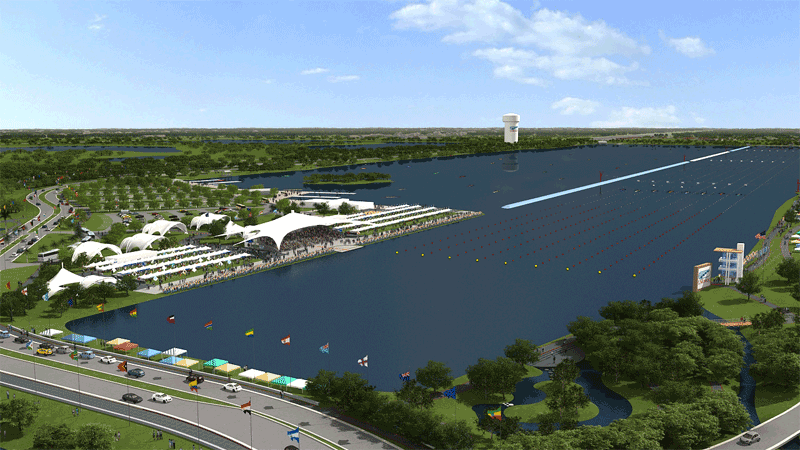
Benderson Park

The Oklahoma River of Oklahoma City, Oklahoma is located just 110 miles southwest from Tulsa, Oklahoma. There is also a lost Hudson seat lying somewhere on the river bottom, left there after I flipped my single during a set of “power 10s” when my oar found the broad side of a buoy marker. The Oklahoma River was named an official U.S. Olympic and Paralympic Training Site for both rowing and canoe/kayak in 2009 and is a FISA-approved racecourse. Located on the banks of the Oklahoma River, the OKC National High Performance Center is the headquarters for the USRowing Lightweight National Team and has been named the National Adaptive (Para-Rowing) Training Center. The site has hosted the 2007 and 2011 USA Rowing World Challenge as well as the USRowing Master’s National Championships in 2011.

Lake Natoma located in Gold River, California just outside Sacramento seems like it would be the obvious site if the Olympics were to go to San Francisco, San Jose or Sacramento. Lake Natoma was part of the San Francisco Bay Area’s bid for the 2012 Olympic Games. The site has also hosted several NCAA Women’s Rowing Championships (2011, 2010, 2008, 2005 and 2004).

Staying in California, if the bid were to go to San Diego there are a couple of options for a rowing venue. The San Diego Crew Classic takes place every spring in Mission Bay. The 2,000-meter course spans a stretch of the bay, starting nearing the Sea World Towers and finishing near Crown Point Shores. About 10 miles south of San Diego is the U.S. Olympic Training Center in Chula Vista and the Lower Otay Reservoir. Chula hosted the National Selection Regatta I and II, Paralympic Trials, and the Non-Qualified Olympic Small Boat Trials in 2012. The training center has become the winter training site for the U.S. men’s and women’s rowing teams. As with most any of the rowing venues in the U.S., both Mission Bay and the Lower Otay Lake would require extensive construction and development to create an Olympic rowing venue.

Oak Ridge, Tennessee is home to Melton Hill Lake located about two and half hours outside of Nashville. I have never visited, but I’ve heard it’s absolutely beautiful and is known as one of the best rowing venues in the U.S. The 2,000-meter course provides seven straight lanes fully buoyed, protected by hills on each side. Oak Ridge hosted the USRowing National Championships in 1997 and 2000 and will host the 2013 USRowing Youth National Championships.

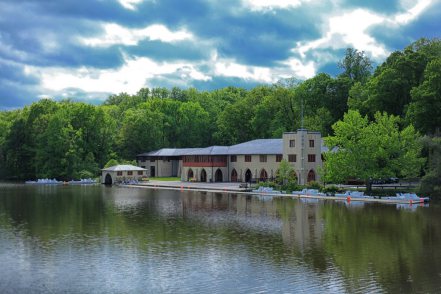
While Philadelphia, Pennsylvania is home to the iconic Boathouse Row on the Schuylkill River, there’s no way this narrow stretch of river nestled in the heart of Philly would be the site of any Olympic Rowing events. My guess is the course would be one of two places: Mercer County Park in West Windsor, NJ or the Cooper River in Camden, NJ. The same goes for if the Games were to go to New York, NY; these two sites would most likely be the nearest race venues.

I’ve never rowed the Cooper River, but there is a 2,000-meter, narrow straightaway that fits 6 race lanes. The Intercollegiate Rowing Associations Championships (IRAs) have been held there every year since 1995, with the exception of 2009. While it is probably one of the nation’s most used racecourses, it still has a list of issues. During the summer of 2012, it was announced that Cooper River Park would undergo a 5-year multimillion-dollar facelift to enhance the river and surrounding grounds. The project was set to begin that following winter because “both rowing and local officials recognize its potential as a world class rowing venue.” One goal of those enhancements would be to host international competitions. FISA has previously indicated that some aspects of the venue make it unsuitable for hosting a World Championship (or an Olympic Games). The 5-year facelift is scheduled to be complete by 2017, just in time for the 2024 host city bids.

Mercer County Park of West Windsor, New Jersey is home to the Finn Caspersen Rowing Center and has been designated by the USOC and USRowing as an official U.S. Olympic Training Site for rowing through 2018. If you’re an elite rower in the U.S., you have probably been to at least one National Selection Regatta or National Championship held on Mercer Lake (I raced my first 2K ever here at the 2011 National Selection Regatta I). The site has hosted the 2012 and 2006 NCAA Championships, five U.S. Olympic Team Trials and the FISA World Masters Rowing Championships in 2006.
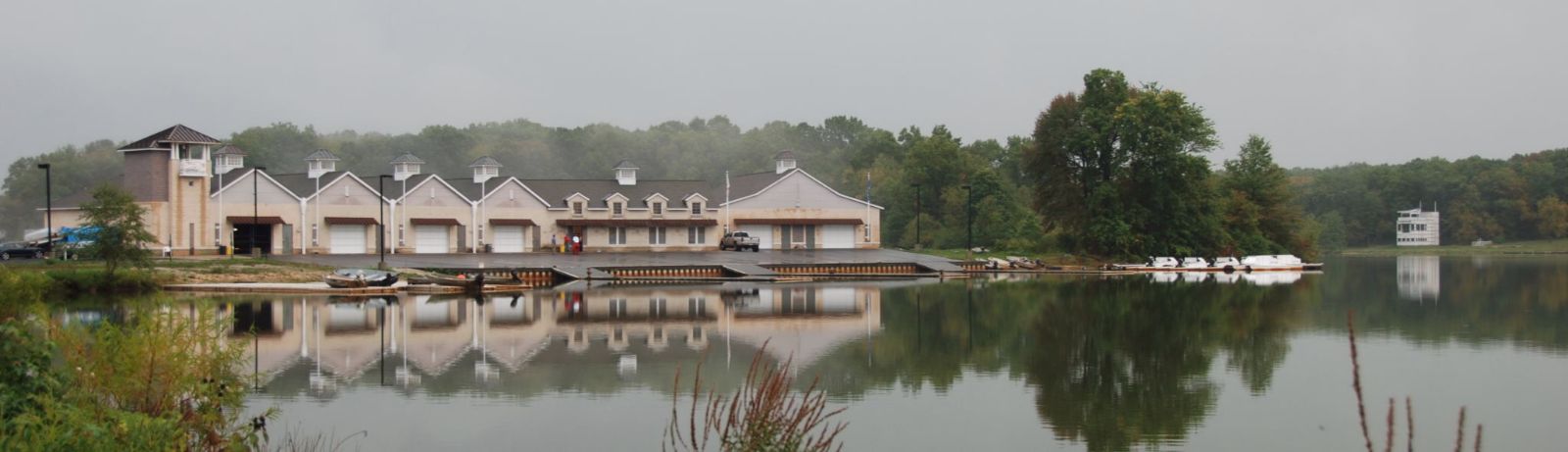
Finn Caspersen Boathouse at Mercer Lake

Finally, with four cities on the list from the Lonestar State, I had to touch on at least one of them. White Rock Lake, located in northeast Dallas, Texas seems to be the place for oarsmen and women. The 1,254-acre city lake is home to the Southern Methodist University Men’s and Women’s Rowing Team, Dallas United Crew, White Rock Rowingand several other programs. The city just approved the construction of a $4 million dollar boathouse to be built on the lake in addition to the already existing White Rock Boathouse.One of the most exciting things that I came across through my research was the widespread enthusiasm and support for rowing. There are cities all across the U.S. putting money into developing boathouses and parks that could potentially host large regattas in the future. It would be wonderful to have the Summer Games brought back to the United States. While I may not be in a boat, I’d love to find myself in the grandstands, perhaps at one of the venues listed above.

A River Runs Through It

Love this book and of course, the movie. I couldn’t help but poach the title. As I was pulling this post together, the phrase popped into my head. So cliché, but so applicable. I’ve used a variety of words and phrases including adventure, journey, and life-changing experience as I’ve written about my dive into rowing that began on the Connecticut River one New England summer morning, nearly two years and two months ago. I still remember the date. I probably always will. June 27, 2010.

Out of curiosity, I spent some time the other night combing through old emails, using search words: “learn to row” and “Riverfront Recapture” which is the Rowing Club in Hartford, Connecticut where I got my first strokes in with the Beginner’s Sculling Class Mondays and Wednesdays 8-9:15am. I was so enthusiastic and such a rookie, but instantly knew I had stumbled upon something that I could not do without. After the first week, I was already begging the coaches to let me start coming early every morning and “get more practice in.” Typical. But I knew this wasn’t something I wanted to recreationally pursue.

On a recent trip back to Connecticut, I had the opportunity to return to Riverfront and spend the afternoon riding in the coach’s launch, helping call starts for pieces-and even a little coaching-as the Riverfront women’s team was preparing for Master’s Nationals. It was so wonderful seeing those women that I experienced my first races with and my beginning of this love affair with rowing. Being reminded of a beginning-that first day of classes, your first presentation at work, or the first 5K race you finish (however terrible the time may seem now)-is both humbling and reviving.

And then my mind wanders through the twists and turns of the past couple of years. So. Much. Has. Happened.

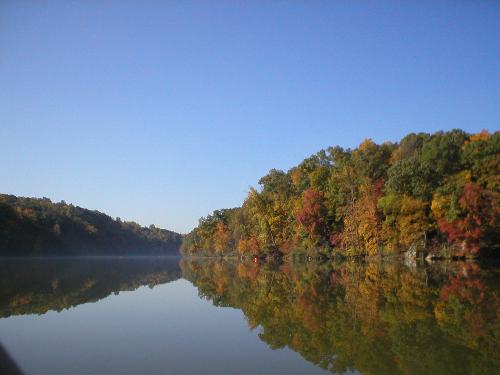
“Heaven on Earth” Rivanna Reservoir - Charlottesville, Virginia.

With the conclusion of the 130th Royal Canadian Henley Regatta last week, the 2012 summer racing season has come to an end. I didn’t come away with the hardware that I collected last year (winning Henley Gold in the Senior Women’s Double and Senior Quad in 2011), but I still had a decent regatta with the point of the week being to have a little fun and get some last racing experience in before the summer ends. Competing in the Senior Women’s Single and the Women’s Championship Single events, I put up four 2K races in four days.

It was my first racing since the Small Boat Olympic Trials in April. I had been sidelined all of May and June with a frustrating broken rib. A huge learning experience that I hope to never endure ever again. Even though I spent those eight weeks rehabbing and working on the bike, running, and cross-training, I was not quite in racing shape for the Henley. I managed to win my heat and semifinals, taking 2nd in the Final (out of an overall 48 competitors) in the Senior Women’s Single. Being the competitor that I am, it wasn’t easy swallowing defeat and knowing that I did not have my best racing. And even if I knew going into it, being out of shape is no fun and a little bit of a kick in the gut.

So it’s back to work. And working harder than ever. The 2012 Olympic Games have passed, and the U.S. Women’s Rowing team had a dominating performance, winning Gold in the 8+ and Bronze in the 4x. Our W2-, W1x and W2x had strong performances as well. Official workouts with the team at the U.S. Training Center in Princeton, NJ start back up in less than two months.The bar is set higher than ever. My application was accepted for my Women’s Championship Single entry for the 48th Head of the Charles in October. In the meantime, I’m off to my little piece of Heaven on Earth, Charlottesville, Virginia for a solid few weeks of good rowing, good coaching, and good people.

“One of life’s quiet excitements is to stand somewhat apart from yourself and watch yourself softly becoming the author of something beautiful even if it is only a floating ash.” -Norman Maclean, A River Runs Through It

“And so here I am, with no regrets…”

This latest blog can also be found on espnW.

————-

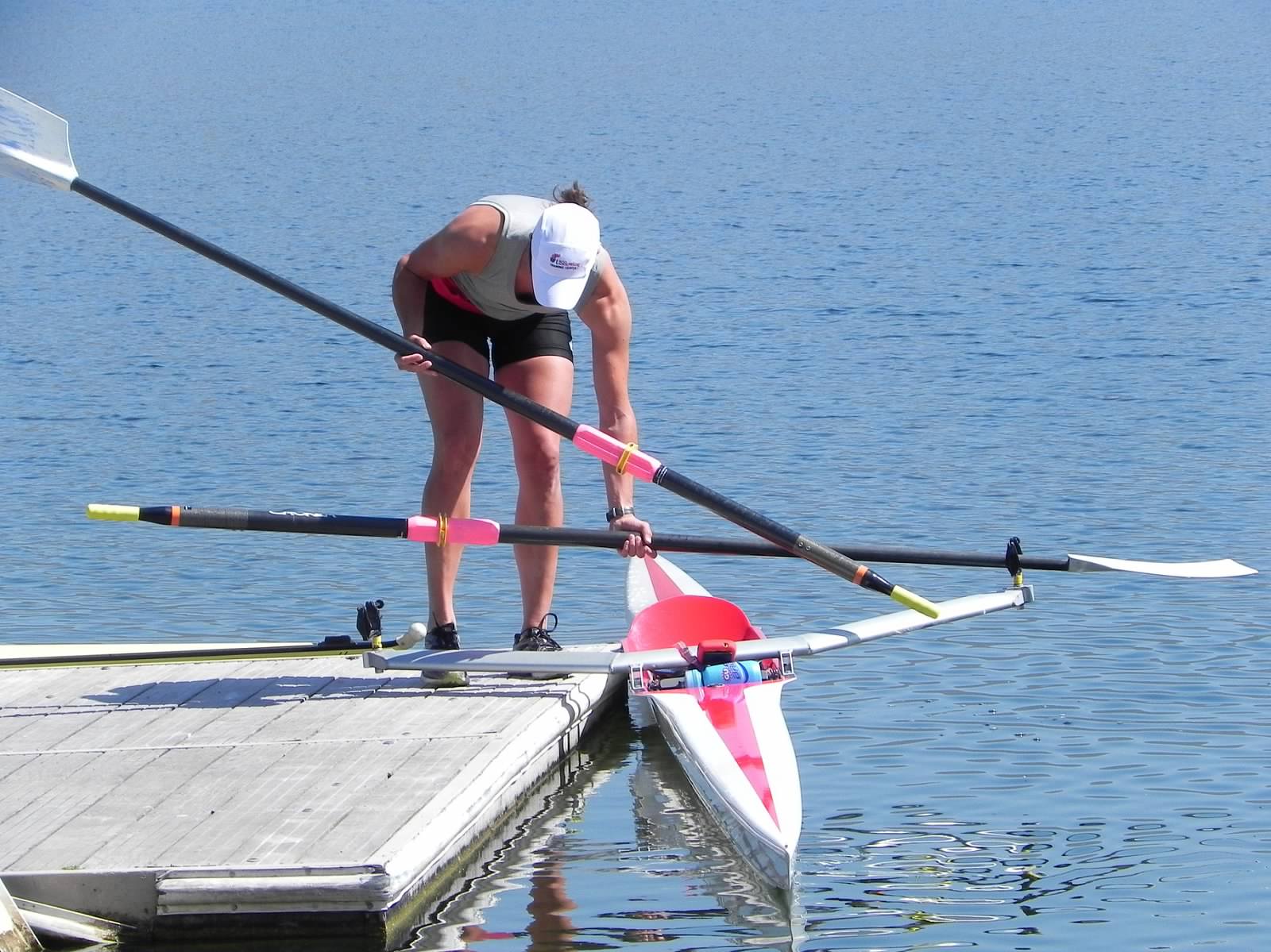
Preparing to launch for an afternoon practice on Otay Lakes.
U.S. Olympic Training Center - Chula Vista, CA.

Many Olympic dreams will come true this year, but not mine.

I’m not allowed to talk publicly about the selection process until the team is officially named on June 22, but I know that I won’t be on that final squad to London. My new target date is 2016, and Rio de Janeiro might just be the destination.

Though I would have loved to make the team, I’m not devastated by any means. I never expected to come this far as quickly as I did, and while I still have a long way to go, it only shows me that the Rio Olympics are a real possibility.

In April I raced the women’s single in the Olympic trials against a formidable field of some of the top scullers in the country — including top U.S. women’s single sculler and Olympic hopeful Gevvie Stone. After an exhausting three days of racing, I went on to win the B Final in a come-from-behind victory, placing fifth overall at the trials. (Check the race out here).

I still shake my head in disbelief when I think about how a year ago, I finished 33rd among a similar field at the 2011 National Selection Regatta I. A year can change everything.

While 2012 isn’t in the cards for me, I’m still training with the U.S. team in Princeton, N.J. It is a privilege and honor to consider myself a part of such an elite group of athletes. I’ve learned invaluable lessons from the brilliant, seemingly invincible women I’m surrounded by every day. From perfecting the “art” of ice baths (hurts so good), to creating the ultimate 6-kilometer erg test playlist, to learning how to deal with rowing-related injuries, and pushing beyond my known limits because everyone else is willing to go there with me, I no longer feel like the rookie that I was just less than a year ago.

The progress I’ve made only baits me to continue working hard and see my Olympic dream to a reality in Rio. So we continue — those of us that won’t be hopping the pond to London in July — to train day in and day out, putting in the countless hours as we hope to represent the United States in future World Cup events, world championships and in four more years, the Olympics.
Shea Rowing Center / Princeton Boathouse. Princeton, NJ.
Courtesy of Aaron Cropper.

I read recently that the odds of winning an Olympic medal are about 662,000 to 1. I don’t know how this was calculated, but apparently you are more likely to be struck by lightning than to win an Olympic medal. Nine months ago, I decided to leave a full-time job with a promising future to pursue my dream of becoming an Olympian. I left my home, my friends, and my comfy desk job to chase what many would consider a lofty, perhaps even ridiculous goal.

When making this huge life-changing decision, the idea of failure didn’t even cross my mind. I knew what I wanted, and I knew I would do everything to put myself in the position to achieve that. And so here I am, with no regrets. Aside from the athletic gains (I seriously think I could run a respectable time in a marathon tomorrow if I had to), I have learned so much about myself, formed lifelong relationships, and am collecting a pretty amazing album of memories that I’ll carry for a lifetime.

I cannot wait for what’s to come in the next four years. And adding to the “to do” list: Portuguese lessons.