Every rower has at least one thing in common. Other than pulling on one or two sticks and floating around in an expensive piece of carbon-fibre composite for a significant portion of our time, we all experience some sense of nomadism. It’s part of the job and an even more important part of pursuing the Dream.
A typical year will have you traveling across the country, first to a two to three-month training camp for the winter, back home for a few weeks, and then across the country again to compete at the National Trials in the Spring. You have another few weeks at home, which is just enough time to revive your water-deprived plants and put a hold on your mail. If you have a pet, they either hate you or have completely forgotten who you are. At this point you’ve just given up on the unpacking and packing charade and convinced yourself that living out of a suitcase is a skill you should continue to cultivate—even at home with your nice big closet and dresser of drawers. Now it’s time for the real fun: racing season. Maybe summer racing takes you to another country to compete at World Cups and then later, (of course, not before going back home first) to the World Championships. Or perhaps it sends you on the ultimate road trip, driving across the country to any and every regatta you can squeeze in. Regardless of your destination(s), it’s all for this crazy addiction we call a sport.
Following a month of competition and training in Europe, Ellen and I returned to train in Princeton, New Jersey. While Princeton still gets its share of heat and humidity, it’s nothing like the 100+ degrees (Fahrenheit) we’d be experiencing every day in Oklahoma City. We opted for the former to survive the remainder of the summer before heading to Amsterdam for the 2014 World Rowing Championships in just a few short weeks. When it’s all said and done, we will have spent less than three months over the past year in our actual apartment in OKC. I’m pretty sure at this point the house plants do hate us.
We’re no strangers to Princeton, having just moved to OKC from this quaint little college town last November. For the time that we are here, we’ve been lucky enough to take over the guest bedroom/office in the house that was once our home before we moved, catching up with our old roommate and fellow 2014 National Team member, Megan Kalmoe and her new roommate, Samantha Warren. It’s a happy home of four rowers sharing one tiny bathroom and little kitchen, but enough Netflix and HBO GO to keep everyone happy.
Despite the occasional chaos and headache that comes with always being on the road, the opportunity to meet different people, catch up with old friends, discover something new, and see the world from the seat of that expensive piece of carbon-fibre, is truly living the Dream.
Hello from Lucerne (Luzern)! It has been a busy couple of weeks prior to our arrival here in Switzerland just a few days ago. I wish I could keep this short, but the first week alone was enough for a lengthy and long overdue update. It’s hard to believe Ellen and I are just over halfway through a month of training and racing in Europe. So far we’ve done it all: Planes, Trains and Automobiles…and let’s not forget the important one, Boats. It’s been a ton of fun, exhausting, and at times stressful and difficult; but most importantly, we’re getting the valuable race experience we came here for.
Our “Eurotrip 2014” began on Saturday, June 14 with our traveling companions, the lightweight women’s double of Devery Karz and Michele Sechser and our coach Jeremy Ivey. We took a very early morning flight out of Oklahoma City to Newark, New Jersey where we enjoyed a six hour layover before departing for Geneva, Switzerland later that evening. Best way to kill that much time? Find a local gym that will accept guest day passes and squeeze in a solid workout and shower. Seriously. Best decision ever. The workout itself broke up the grogginess of a full day of travel as well as got the endorphins flowing so we didn’t feel as terrible after the eight hour flight filled with crying children, variable sleep, mediocre food, and dehydration. And as elite rowers, days lost to traveling oftentimes equates to missed valuable training days so it was great to feel like we hadn’t wasted an entire day. Special thanks to ClubMetro Newark for supporting Team USA and welcoming us into their fitness facility!
After landing in Geneva on Sunday morning (June 15), we met the rest of the USRowing conglomerate who had traveled on a separate flight, before loading onto a large tour bus that took us an hour and half south across the border into France to the small town of Aix-Les-Bains nestled in the Alps region on Lac du Bourget. Including all athletes, coaches, and other related personnel, Team USA included about 50 people total, one of the larger groups we’ve traveled to a World Rowing Cup.
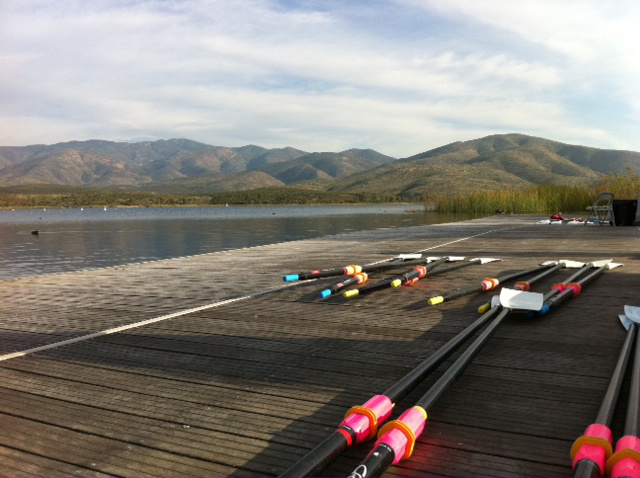
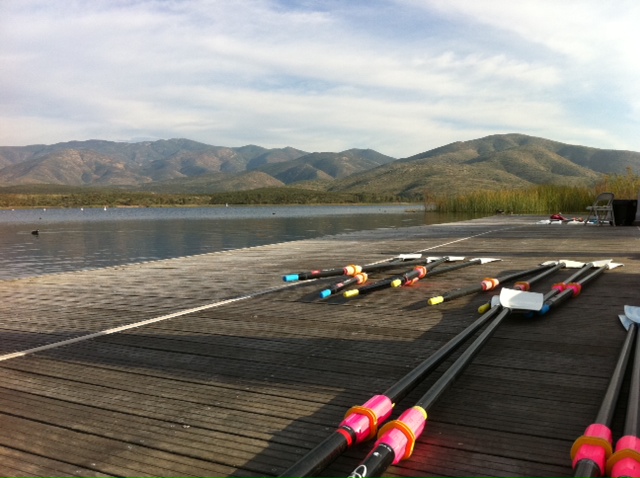
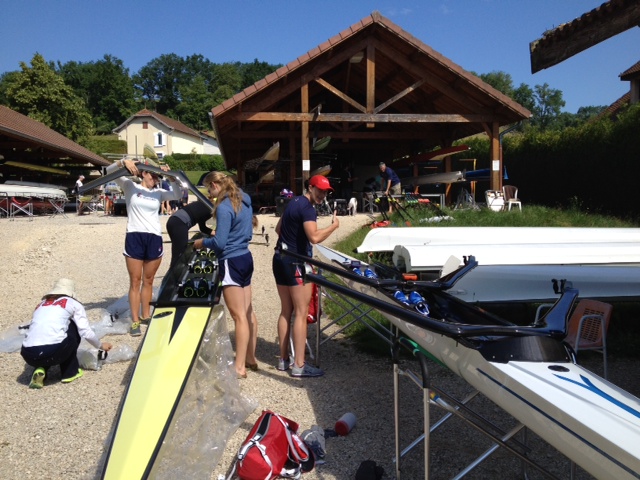
Rigging the boats for training at Aviron du Lac Bleu in Paladru, France.
World Cup 2 took place on the beautiful Lac d’Aiguebelette June 20-22. The course didn’t open to outside countries for training until June 18 which posed a problem for getting those critical first strokes in to adjust to a new boat, new water, and shake off the sometimes paralyzing jet lag. Fortunately, we had arranged to train at an alternate location out of a nearby (and very hospitable) club, Aviron du Lac Bleu located in Paladru for the two days we weren’t allowed to be on Aiguebelette. It was about a 75 minute trek from the hotel which made for long days, and the open water and variable conditions made for bumpy rowing, but we made it work.
To put it mildly, the week leading up to racing didn’t go exactly as planned. (Really, in life when do things ever go exactly as planned?) Race week is already stressful enough so when you hit those bumps along the way, your blood pressure tends to irrationally skyrocket and the crazy eyes come out. Despite some challenging issues, by the morning of our first race Ellen and I were prepared and confident as we paddled to the starting line.
The heats were unique in that they were conducted in a time trial format (as opposed to six boats across racing). At least once during each Olympic quadrennial, FISA will simulate the time trial to ensure officials and crews are prepared in the event that it may be necessary (most likely due to weather conditions that would prevent fair racing). This way of “racing” is not exactly ideal because you can’t truly gauge your speed off of other crews; you’re basically racing the clock, hoping you put up the fastest time. In our time trial heat, we took second behind Australia, a fast crew which had taken gold at the first World Cup in March. Our finish advanced us straight to the semifinals to be raced the next afternoon.
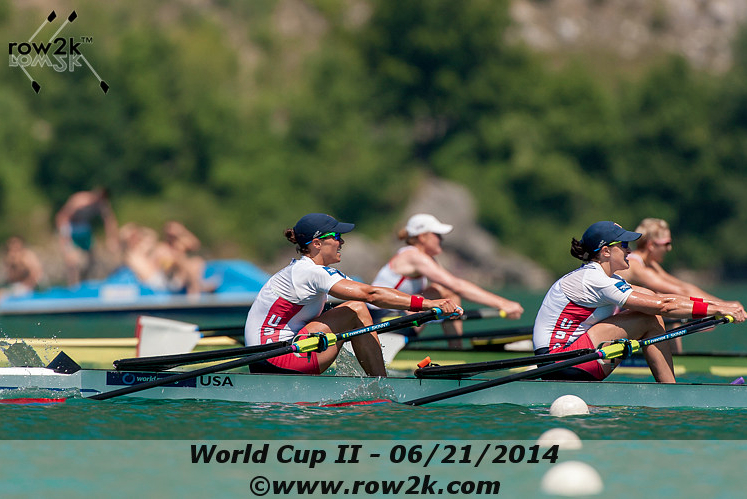
Final strokes of our semifinal at World Cup 2. (Photo courtesy of row2k.com, Erik Dresser)
The semifinal was a bit more exciting: side by side racing and we were lined up against a very fast Polish double-the 2014 European Champions-along with Great Britain, China 1, China 2, and Finland. We needed to place in the top three to qualify for the A Final as well as secure our seats on the 2014 United States National Team. This was a big one. We fought our way down the course, neck and neck with Great Britain trading places for second and third, finally passing through them in the last five hundred to take second, less than half a length behind Poland in first. We were pumped. We had raced well enough to make the A Final and to be awarded a decent lane as well as officially punched our tickets to the 2014 World Championships!
The A Final took place on Sunday, June 22. Our rowing had been coming together better and smoother with each day as we settled into the new boat and fine-tuned some tricky rigging. Having officially qualified for the National Team and with that little bit of weight off our shoulders, we were ready to lay it all out in the final which was stacked with nothing but strong, fast crews.
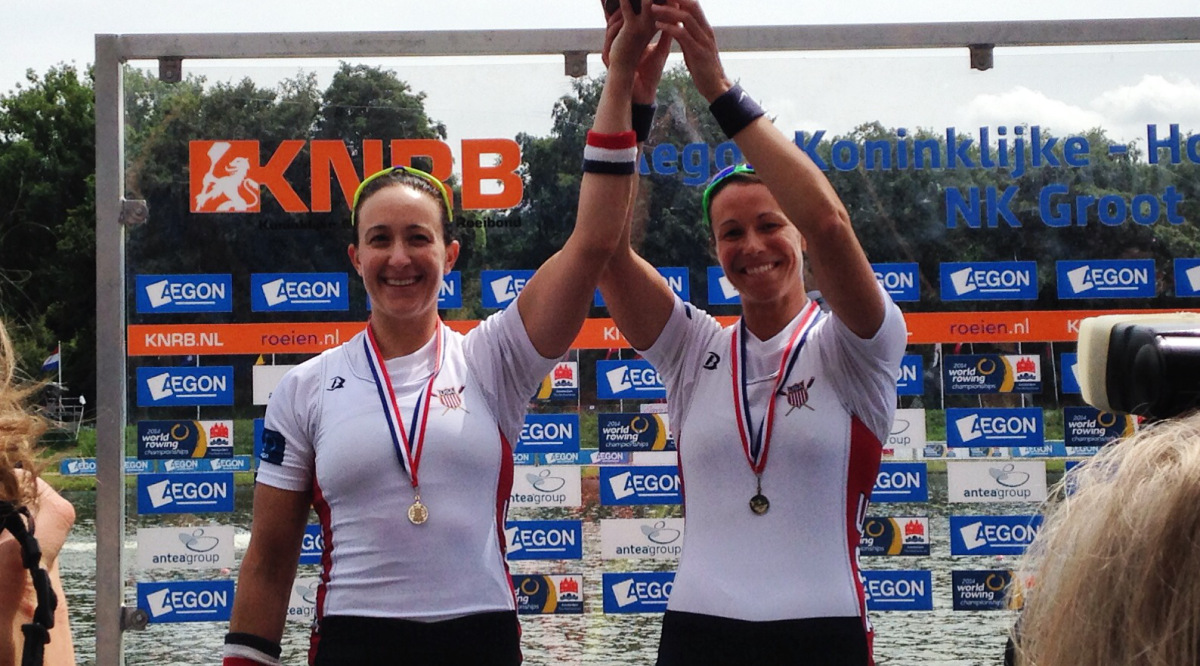
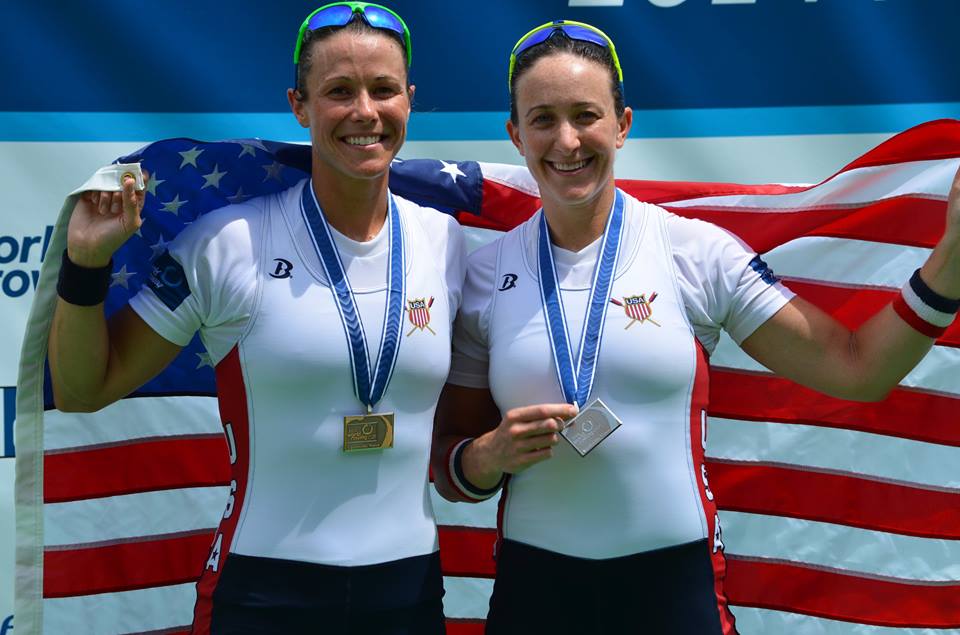
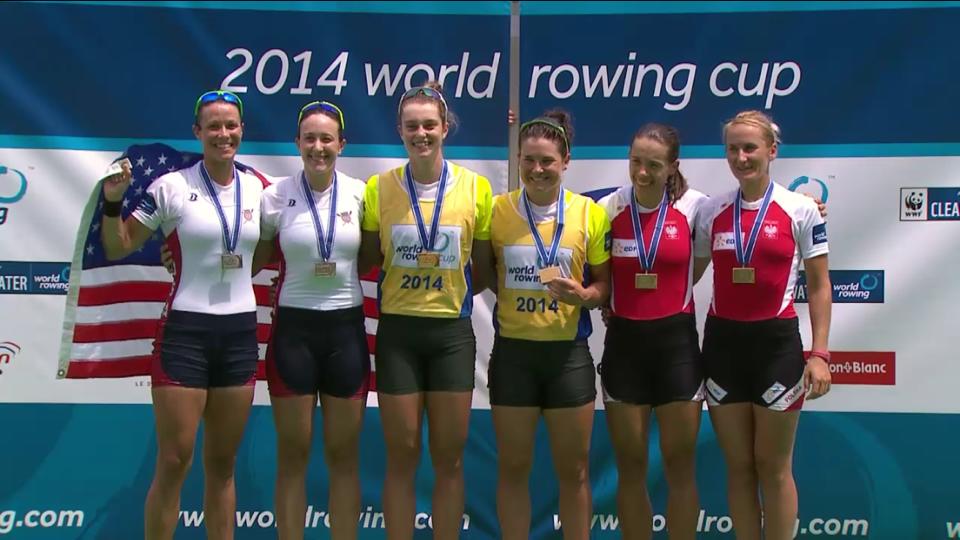
2014 World Cup 2 Women’s Double medalists (L-R: United States, Australia, Poland).
From the competitive racing seen in the heats and semifinals, this race promised to be an all out battle to the line, six boats across. As we pulled into the starting dock in lane five, I looked to the left: the Netherlands, Belarus, Australia and Poland; glanced to the right: Great Britain.
We blasted off the line at a 51 (insanity…thanks, Ellen), determined to stay up with Australia and Poland, who would surely be leading in the first 500 meters. As expected, the race was a 2,000-meter all out battle. Australia led from start to finish with Poland in second until we made a decisive push coming into the third 500. We made a run at Australia in the last 250 meters, finishing just a half length behind to take silver. All crews finished fast with first, second and third separated by less than a boat length and the entire field within seven seconds of each other. For Ellen and me, it was our second World Cup and best international finish as a crew. We were very pleased and proud of our performance and even hungrier to take that next step. Check out the replay of the race HERE.
Following World Cup 2, the team packed up and flew to Amsterdam where we trained on the Bosbaan for the week and raced in the Holland Beker Regatta (June 28-29). Amsterdam is a very cool city. Ellen and I raced in the women’s double sculls event both days, going 4-4 winning each heat and final to take home two gold medals. Needless to say we were pretty tired after four races in 48 hours. The racing may have not been our prettiest, but it was a great way to get an early look at the Bosbaan where the World Championships will be held later this summer (August 24-31).
The women’s double is shaping up to be one of the strongest, deepest, and most competitive fields the event has seen in several years. It truly is an honor to race against some of the best athletes in the world. There will be no “easy” races as crews will only get faster as we near the World Championships. World Cup 3 (July 11-13) is coming up in just ten days and the entry list for the women’s double is larger and just as fast (if not faster) than in France. Looking forward to another regatta filled with tough racing!
Wow, so it’s already March. I figured it was about time to put down my “2014 Resolutions” so that I have something to reflect on and keep me honest as the months creep closer to another year passing. With the Sochi 2014 Olympics having just wrapped up (and the Sochi 2014 Paralympics about to begin!), I thought what better time than now to revisit my goals on the road to Rio 2016.
It’s interesting how with the turn of a year, so many people want to hit this huge “start over” button. “This year I am going to completely stop (insert terrible habit),” or “I’m going to start this brand new (insert latest diet or fitness trend).” That is all well and fine, but I like to avoid this idea of erasing last year’s “faults” or completely overhauling my daily routine. Yes, the beginning of the year does signify a new beginning and in a sense, the turning of a page. We live and we learn and we make daily improvements. This attitude should not be limited to December 31st and January 1st.
Obviously, I’m a little late to the game in “setting my resolutions” for 2014. I’ve never been one to get all hyped about “New Year’s Resolutions” but I do like to take the time to think about what it is I want to accomplish in the coming months: how can I work toward becoming a better athlete, friend, daughter, partner and just overall a stronger person? What do I want to do this year that gets me closer to where I want to be next year? What do I want to learn about myself and about the world? These are the questions I tend to ask myself when deciding what kinds of goals I wish to set for the year and beyond.
As a fun practice I took a look at a post I put out a few years ago in January of 2011, Resolutions to Rio, when I first picked up the sport of rowing. Literally, I had just began training and it is very evident in those goals. As I laughed at the 2011 version of myself writing down those goals, I also couldn’t help but appreciate the value of them. As ridiculous as they are to me now, they were so meaningful at the time. And the best part? I blasted through every single goal I set that year from the erg standards, to buying my first single, to making it to the National Team Training Center in Princeton. So while I was laughing at my 2011 self, I was giving her a big pat on the back.
Now it’s time to tackle a bigger plate in 2014. I won’t bore you by delving into the non-rowing components of my 2014 resolutions. But for all you rowers and elite athletes out there, perhaps this will inspire you to take a look (or a second look) at your own plan, how far you’ve already come and how you are working toward becoming the best version of yourself that you can this year. And if you’ve already slipped on your “2014 Resolutions,” don’t give up. Every day is a new start to something beautiful, something meaningful. Every day counts.
Resolutions to Rio, Take 2:
Stay Healthy. If I’ve learned anything in my time training at the elite level, it is the importance of staying healthy. With the amount of volume a sport like rowing demands of the body to be successful, injury is common. Obviously it’s not a contact sport where we are throwing our bodies against the ground or at other people with the risk of broken and dislocated limbs, but the number of hours the body is working and in constant, repetitive motion, can lead to serious overuse injuries. Those injuries like strained and torn muscles or broken ribs (the worst!) can put a rower out of the game for several weeks to several months, severely impacting their ability to train and be ready to perform when competition starts.
At this level, everyone works hard. Sometimes it takes a lot more mental strength to say “I need to cross-train this session” or even “I need the afternoon off” when you may not feel well. I’m no spring chicken and don’t bounce back from things like I used to when I was 18 years old. Listening to my body and not being stubborn (stupid) like I have in the past, will be critical to staying healthy and being able to train day in and day out without the jarring disruption of an injury.
I have made it a habit to spend a solid 20-30 minutes before practice to properly warm up and run through a routine of strengthening exercises. In the same way, I spend another 30 minutes cooling down and stretching after practice to make sure any muscles that might have tightened up are settled down and loose. Creating and sticking to habits like these can make the difference between standing on the medals podium or watching from the stands.
Manage the Emotional and Mental Ups and Downs of Training. This is a big one. Rowing has frustrated me and tried my patience in ways that no other sport has in my entire athletic career. Now only in my fourth year of rowing, I still continue to learn a great deal every day, which in turn only shows me how much more I have to learn. Every elite rower is a perfectionist in some way; it’s what draws us to the sport, it’s what keeps us addicted to the sport. We are all pursuing the perfect stroke, the perfect training plan, the perfect recovery techniques, the perfect race. Frankly, it can be a bit maddening.
With anything we put a significant amount of our time and effort in, it’s important to remain level. Don’t ride the highs too high and don’t let the lows bury you. Particularly in a sport like rowing, you’re going to have days that make you feel like you are ready for the world stage, only to be knocked down by days that will absolutely destroy you physically, mentally, and emotionally.
I’m still navigating the ways of finding my peace with the tough days. I think it’ll be important to remember the enjoyment of the small victories and to use those as armor for those particularly rough workouts. Once you reach a certain level, progress can become seemingly unnoticeable. Overnight transformations are rare in rowing but it’s the subtle, day-to-day improvements that lead to the big changes. It’s difficult to give yourself a pat on the back, but constantly giving yourself a kick in the ass sometimes proves more detrimental to moving forward. When I first started rowing, I was delighted by the smallest improvement; that’s the joy of a steep learning curve. When you achieve a certain level of “success,” the expectations for yourself become that much higher and in turn, the pressure you put on yourself is that much heavier. It’s how good athletes become great athletes. Never settled, never satisfied. Balancing this mentality with the ability to not get dragged down by an “off” or frustrating day, is a challenge for so many athletes (finger pointed at myself, “this guy”).
As I continue becoming a better athlete, I’d also like to become better at taking each day in stride. Rather, as I become better at taking each day in stride, I will become a better athlete.
Win the 2014 USRowing National Selection Regatta #2. This is a little more concrete, black and white than the previous resolutions may be. Winning the USRowing National Selection Regatta #2 in the women’s double is the first step toward qualifying the women’s double and thereby representing the United States at the 2014 World Rowing Championships. It all starts with this first competition which will take place May 14-17th on Mercer Lake in West Windsor, New Jersey. I predict that the fight for securing spots in the women’s double will become even more competitive over the next several years. Selection procedures have slightly changed this year (2014 Official Selection Procedure), and some would feel the new procedure makes it even more challenging for athletes outside of the Training Center to find their way into a camp boat (eight, quad, and four).
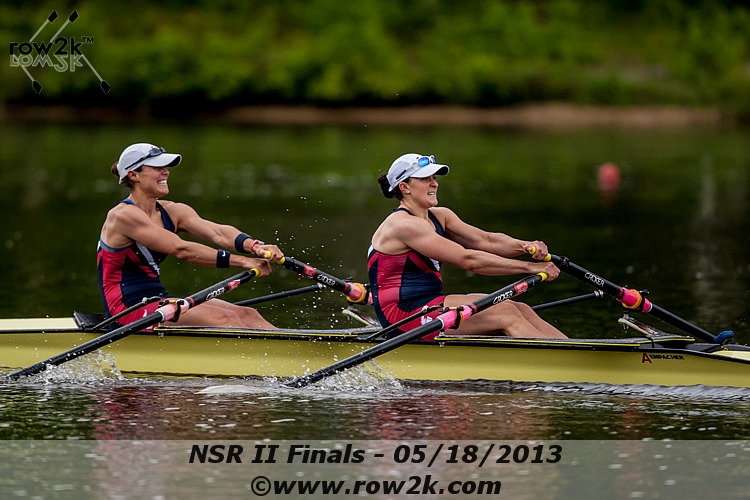
Meghan O’Leary and Ellen Tomek, winner of 2013 NSR #2. Photo courtesy of row2k.com
Basically, if you are an openweight woman training outside of the USRowing Training Center in Princeton, in order to secure a spot on the National Team, you either win the women’s single or the women’s double. Okay technically, you can also win the pair, but I’m not sure the last time an outside women’s pair won an NSR. It’s been a very long time. If you’re a top sweeper, you’re most likely already in Princeton. Since the single and double are no longer deemed “priority boats” and specifically not being developed in Princeton, it only makes sense that outside athletes would be gunning for those three coveted spots.
As a result of some of the structural and procedural changes, most of the nation’s top scullers are training outside of Princeton right now; with more good athletes than there are spots to be filled. This is a GREAT thing because it means the depth of U.S. women’s sculling is growing stronger and stronger, as it needs to, in order for us to be competitive in the women’s single and double internationally. I predict the National Selection Regatta #2 will be a super competitive field this year.
Qualify the Women’s Double for World Championships. Next up? You guessed it. Qualifying the women’s double at a World Cup means you don’t have to take the boat back to U.S. Trials to then qualify for the World Championships. In the United States, you have to place in the top six at a world cup to automatically qualify the women’s double for the World Championships. Top four gets you funding. As part of this qualification goal, I’d like to take home a World Cup medal. Last year, Ellen Tomek and I brought home bronze from World Cup 3 in Lucerne. This year: bronze or better. The qualification world cups this year will be World Cup 2 in Aiguebelette, France (June 20-22) and World Cup 3 in Lucerne, Switzerland (July 11-13).
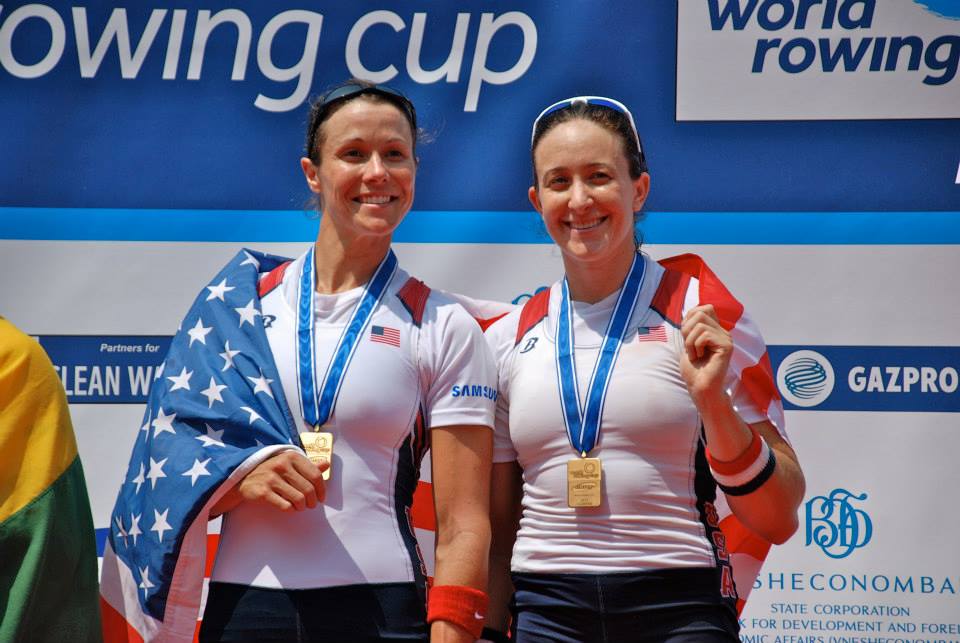
(L-R) Meghan O’Leary, Ellen Tomek; 2013 Samsung World Rowing Cup III Women’s Double Bronze Medalists
Medal at the 2014 World Championships. The last and most important leg of the 2014 racing season: the 2014 World Rowing Championships in Amsterdam, Netherlands (August 24-31). Last year was my first time to compete as a member of the United States National Team at the World Rowing Championships. My boatmate, Ellen Tomek and I won the B Final, placing 7th overall in the women’s double event. Both of us feel strongly that this was an underperformance, and that if we had raced our best, we belonged among the top four boats in the A Final. Were we good enough to be World Champions last year? No; the Lithuanian double (gold) and Kiwis (silver) put up the best race of the regatta and perhaps the best race the women’s double event has seen in several years. Seriously, if you haven’t watched it yet, you need to check it out HERE.
Last year we were a young crew, having only been in a boat together for a couple of months before racing at Worlds. If all goes well (win NSR #2, qualify at a World Cup…), I’m looking forward to competing this year with a little more experience and better preparation to race how we know how to race. Dare I say that the women’s double is looking to be one of the most competitive events this quadrennial, with a very talented and experienced field of athletes. No race will be a “gimme” or easy pass; and that’s the most exciting part! The United States has never medaled the women’s double at the World Championships. I’d like to change that.
In 2011, I was five for five on my New Year’s rowing resolutions. Obviously it would be fantastic to have a repeat performance and go five for five again this year.